Role of a Teacher in Language Learning
The role and function of a teacher is to develop and provide students with the necessary skills to become high functioning members who make a positive contribution to society. In relation to second language learners this means ensuring they maintain and develop their skills in both their first, second and in some cases third language.
It is important teachers familiarise themselves with the Australian Professional Teaching Standards as this outlines the roles and functions of a teacher in providing support and additional learning for EAL/D and struggling students. Standard 1.3 under ‘Teach’ outlines the role of a teacher of ‘Students with diverse linguistic, cultural, religious and socioeconomic backgrounds’ stating “Demonstrate knowledge of teaching strategies that are responsive to the learning strengths and needs of students from diverse linguistic, cultural, religious and socioeconomic backgrounds.” (aitsl, 2020). For further information on the role of a teacher and how to ensure the Australian professional standards are being met both within the classroom and wider school community please access The Australian Professional Teaching Standards via https://www.aitsl.edu.au/teach/standards
What is Language Learning:
Language is the code a person uses to express meaning and communicate thoughts and ideas to others. Language is considered ‘functional’ as it can be analysed according to three functions (Gibbons, 2015, p.5):

- Field: what the key ideas are, and the type of vocabulary used to express the key ideas.
- Tenor: the relationship the author and the audience have (e.g. what common knowledge is shared between a reader and a writer about a subject).
- Mode: how the text is constructed. (Is it spoken or written? Is it formal or informal?)
A teacher’s role in relation to language learning is to provide students with the skills and knowledge to be able to deconstruct spoken and written forms of communication in order to determine the meaning behind the message an author is presenting. This can be a complicated process that occurs through the implementation of a number of language learning theories and practices.
There are a number of language learning theories teachers can apply to develop both native speakers and EAL/D student’s language proficiency. The following will outline strategies and practices teachers can use to develop student’s skills in the identification and implementation of the three functions of language within the four skills reading, writing, listening and speaking.
Reading:

It is important to explicitly teach language units to students as different languages use different language units. Language units can be sound based for example English. Language units can be syllable based for example Latin or they can be meaning based for example Japanese Kunji. The role of the teacher in student’s reading development is to equip student’s with the effective tools and resources to become skilled readers.
To derive meaning through reading both the Low level cognitive process and High level cognitive process of the working memory must work together.
Low Level Cognitive Process (Grabe, 2019):
Word recognition is a reader’s ability to recognise and understand the meaning of words correctly and effortlessly.
Syntactic parsing is a readers ability to understand, apply and interpret the information of individual words and store them together to make grammatical sense. For students to become skilled readers it is essential they develop their syntactic parsing ability, this often requires understanding of grammar at clause level.
Semantic proposition formation is the ability to make sense of new information, word meaning and structural information to understand the message of the written text.
Higher Level Cognitive Process (Grabe, 2019):
Higher level cognitive process of reading outlines two models which surround the explicit teaching of reading comprehension skills.
- Text model reading, the initial summary of the main ideas represented within the text. The ‘Text model reading’ involves writing and discussing summaries on the text, simple recall of information represented within the text and questions related to the text.
- Situation model, how the readers prior knowledge about the text contributes to their ability to anticipate what will come next. The ‘Situation model’ involves critical evaluation of the text and interpretation of implicit meaning.
Reading Strategies:
There are many reading strategies teachers can teach students to ensure they are appropriately equipped with the right tools to become skilled readers. The Reading Rockets website provides an extensive list and examples on how to incorporate effective, research-based classroom strategies to develop student’s lower and higher level cognitive processes. The Reading Rockets website is accessible via https://www.readingrockets.org/strategies
Writing:
The development of student’s writing skills is a process of joint construction between the teacher and the student. It builds on the student’s understanding of spoken language and requires them to provide all information including context of the text for the audience to understand what is being communicated. The process of teaching writing to students requires a large amount of scaffolding and implemented using the following process.
Scaffolding:
The following scaffolding model has been adapted from the Victorian Governments ‘Teaching and Learning Cycle’ for a more in depth description and further resources please visit https://www.education.vic.gov.au/school/teachers/teachingresources/discipline/english/literacy/Pages/using-the-teaching-and-learning-cycle-with-eald-learners.aspx.

Building the field: requires teacher-guided support to choose a topic/theme/genre of interest students already know about and are interested in writing on. The development of visual resources to reflect the new topic. This may consist of ‘word walls, pictures and a display of books relevant to the topic.

Modelling and Deconstructing: involves the identification of the genre of text students will produce. As a class students explore a number of examples of writing on the topic/theme in the genre of writing the students will be producing. Through the exploration of the examples, with guidance from the teacher, students will identify and talk about the grammar and vocabulary related to the topic.

Joint construction: Requires the teacher to lead writing of a model with student input. During and after the development of the model the teacher and students will create a checklist to identify the features of the genre (the structure and associated grammar features.)
Independent Construction: Students will construct their own individual piece of writing in the chosen genre and on the chosen structure using the previously developed check list. If required the teacher will assist students to help develop their ideas to ensure their writing is cohesive.
Listening:

Developing student’s listening skills is essential for their success both academically and socially within school. Listening comprehension is a complex process that requires an understanding of sound distinction, knowledge of vocabulary and text structure to determine the message being communicated (Vandergift, 1999: 168).
The Victorian Government: Department of Education outlines the functional skills of listening as:
- distinguishing the sounds of the English language
- discovering sound-letter relationships
- decoding the sounds, recognising words, and recalling or predicting the meaning of those words
- building understanding of rhyme, rhythm and the sounds of the English language
- building meaning from words, sentences and texts
- connecting meaning to context, and making decisions about how to respond
- building meaning from prosodic features (stress, pitch, intonation)
- applying these skills to increasingly academic and decontextualised topics (Gibbons, 2002:, p. 102-103).
For further information on the functional skills of listening visit the Victorian State Government: Training and Education ‘Literacy Teaching Tool Kit’ accessible via https://www.education.vic.gov.au/school/teachers/teachingresources/discipline/english/literacy/speakinglistening/Pages/speaking-and-listening-and-EALD-students.aspx
Listening Learning Theory
The current learning theory surrounding listening education separates listening skills into two categories:
- Bottom up: learning knowledge about sounds, word meanings, grammatical patterns and discourse makers (Gibbons, 2015; p. 196-219)
- Top down: activating student’s prior knowledge and experience to interpret meaning (Gibbons, 2015; p. 196-219)
Teaching and assessing listening skills of EAL/D students can be challenging. It is important to be aware that many EAL/D students, when they begin to learn English, may experience a ‘silent period’ where they do not verbally communicate (Gibbons, 2015; p. 196-219). During this period students are often focused on decoding what is being communicated it is important to not force students to communicate as it can discourage them from using English due to a lack of confidence. When having students participate in class activities provide them with oral prompts or images to label (Gibbons, 2015; p. 196-219).
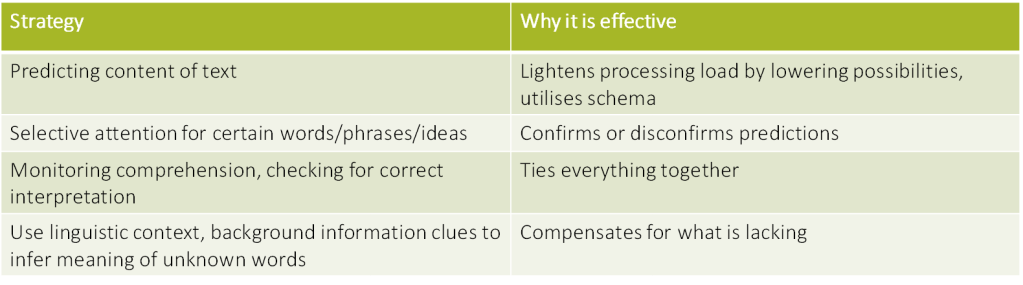
Vanderplank (2008) outlined 4 strategies that can be implemented within the classroom to promote student’s listening skills.
Teaching of Listening:
When planning an activity to develop student’s listening skills the following template can be used:
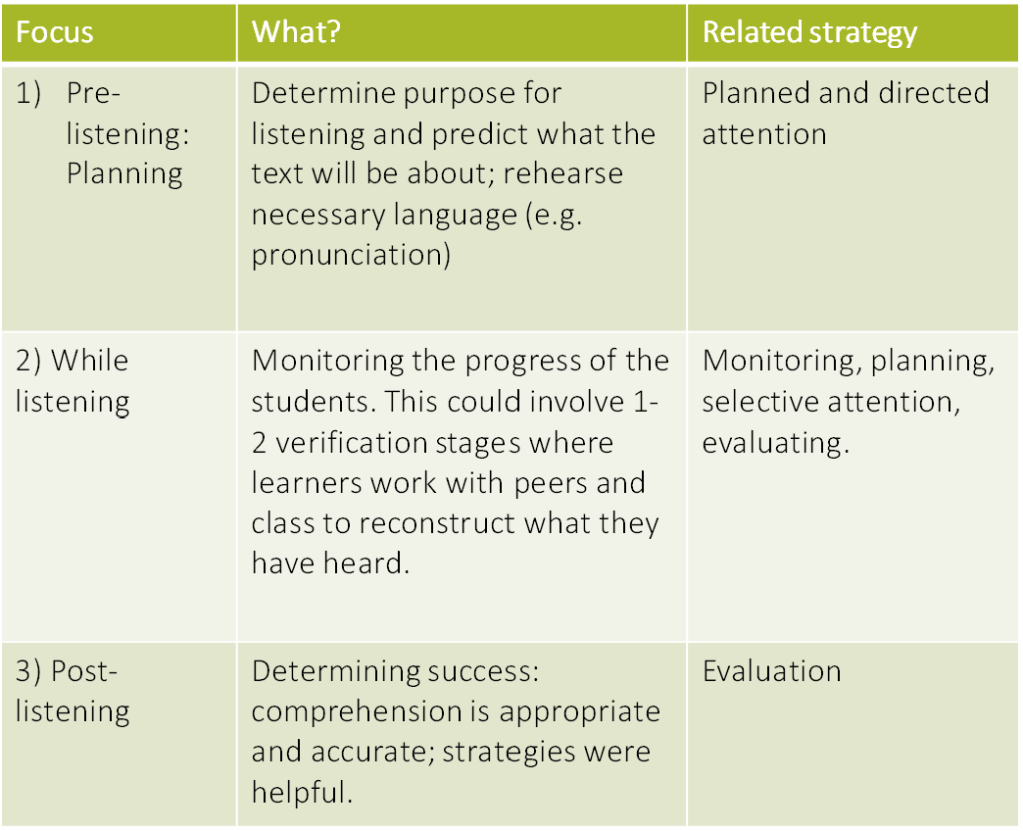
For further resources on targeted listening activities see Pauline Gibbons’ “Scaffolding Language: Scaffolding Learning” (2015) Chapter 7. Gibbons outlines how to appropriately incorporate the proposed lesson structure into classrooms. Gibbons also provides a detailed explanation of strategies of how to assess student’s listening skills and ensure EAL/D students understand classroom instructions and tasks throughout the day.
Speaking:
Speaking is the most important tool for learning. When a person can verbally communicate their idea about a topic/ subject it demonstrates their engagement in learning and ability to clarify ideas and share their own knowledge and experience (Gibbons 2014, p.37-62).
It is important when teaching English verbal commuication skills to explicitly teach and focus on syllable stress and intonation (Gibbons 2014, p.37-62).
- Syllable stress: how we stress syllables at word level
- Intonation: rise and fall of pitch across a sentence/ question/ command
To support student’s oral literacy discussion about curriculum context in all subjects is encouraged. It is important to promote ‘classroom talk’ as students become immersed in purposeful and meaningful talk. To encourage EAL/D students to engage in classroom talk teachers can provide a number of tools to help encourage students. These include:
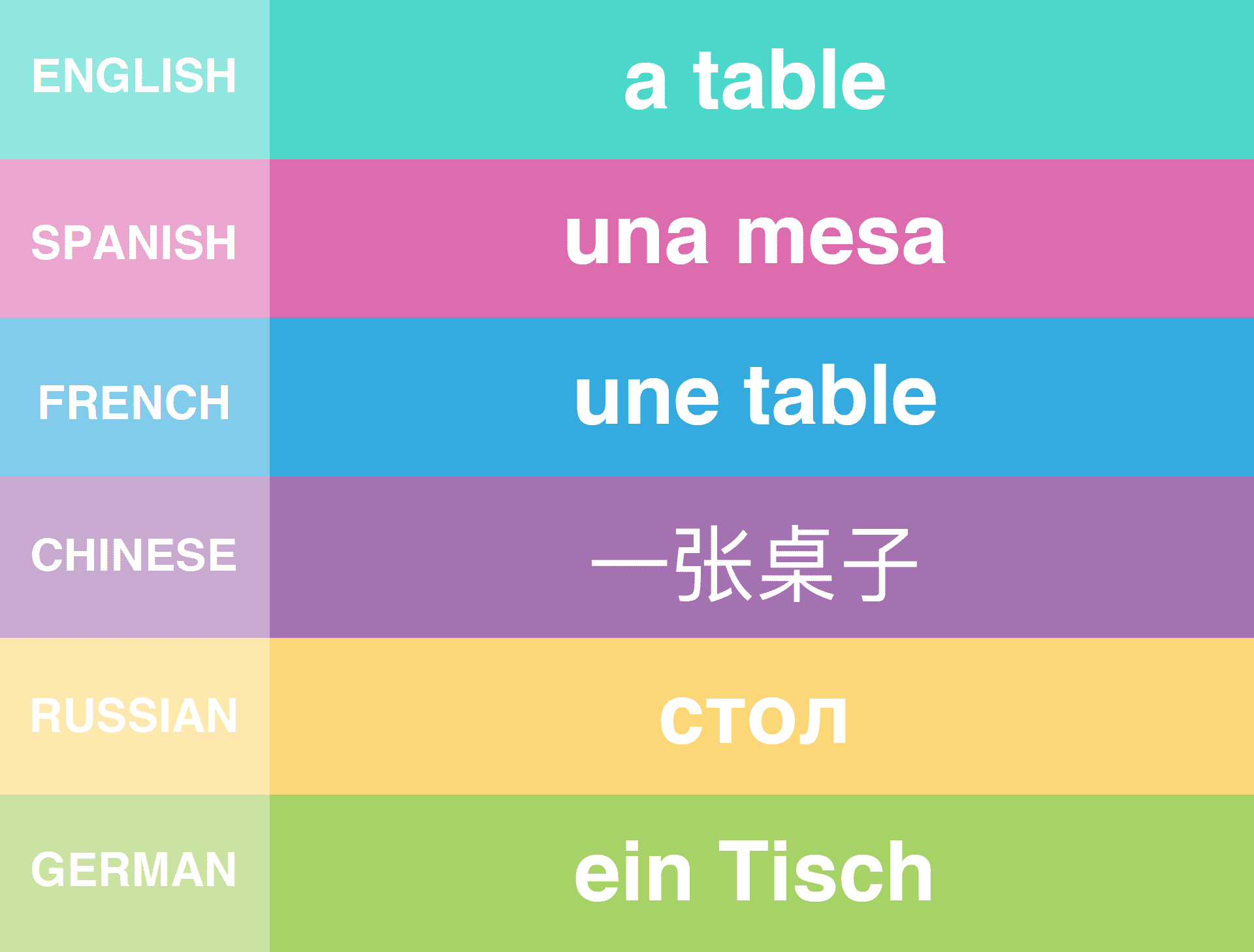
- Visual aids like translation labels. Teachers can label classroom objects in both English and student’s first language. In doing so students are provided with easy access to the translation of objects from their first language to English.
- Prompt cards teachers can implement in the classroom. For EAL/D student’s having prompt cards that outline how to structure a sentence of the form of tense appropriate for a situation can help build their confidence in speaking in English. Jolyon Dodgson, 2014 provides an outline of age appropriate prompt cards teachers can provide students and implement in the classroom. The prompt cards are accessible via https://www.excellentesl4u.com/esl-conversation-cards.html
- Introducing poetry and songs into the classroom is a helpful way to have students engage is structured and familiar speaking patterns. ClassteacherCTLS is a Youtube channel that provides numerous songs and poetry appropriate for all ages. The Youtube channel can be accessed via https://www.youtube.com/channel/UCF4xUUhMRTlg9X6QfbgR28A

- Encourage group work. Place EAL/D students with peers who are confident and effective verbal communicators. By placing EAL/D students with native English speakers they can begin to learn the conventions of spoken English (Gibbons 2014, p.37-62).
Languge Learning Frameworks for Cross Curriculum learning:
Integrated Learning and Language Learning (CLIL)
The Integrated Learning and Language Learning framework outlines learning in both student’s first language and second language. The British Council provides an explanation and examples of how to implement the CLIL framework across the core curriculum subjects https://www.teachingenglish.org.uk/article/clil-a-lesson-framework.
Key concepts surrounding framework:
- the pedagogy can be applied to any educational setting where students are learning two or more languages
- focus is on both languages and content
- it creates an authentic reason to use target language for reasons other than learning the language on its own
4 C’s Framework:
To promote lifelong learning and creative collaboration within classrooms it can be suggested teachers implement the 4 C’s Framework. This framework explicitly teachers in the areas of Content, Cognition, Communication and Culture (Coyle, D., 2018)
Key concepts:
- Content: teach knowledge construction in connection to curriculum subjects
- Cognition: the learning process engaging learners prior knowledge and higher order thinking
- Communication: encourage students to use language to learn and mediate thoughts and ideas
- Culture: the integration of children’s intercultural understanding and development of their global citizenship
Literacy Assessment:
Located on the Australian Curriculum, (accessible via https://www.australiancurriculum.edu.au/resources/national-literacy-and-numeracy-learning-progressions/national-literacy-learning-progression/reading-and-viewing/?subElementId=50915&scaleId=0) is an outline of how to determine a student’s literacy progression in reading, writing, listening and speaking. Set out in a basic table this resource outlines the general literacy capabilities of students at a foundation English level to an advanced English level. By referring to and using the guidelines in addition to the Band Scales teachers can accurately identify the literacy areas they need to provide students with additional help to further enhance their literacy skills.
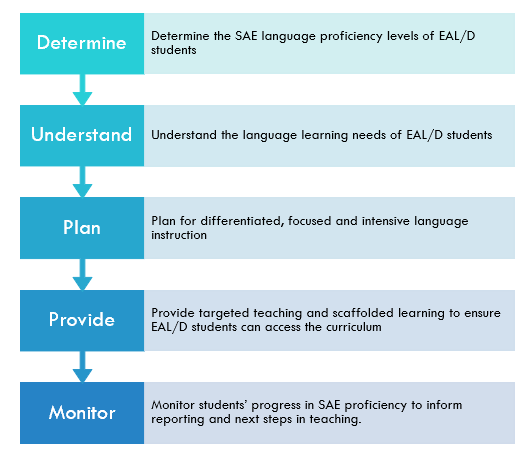
In addition to using the Australian Curriculum ‘Understand how Literacy progression works’ recourse to assess student’s literacy progression the Band Scales can also be used. Band Scales are a Queensland Education System assessment criteria which assists teachers in determining an EAL/D student’s English proficiancy, understanding the language learning needs of the student, developing a focused and intensive language development plan, provide targeted teaching and scaffolded learning goals and ensure students’ language progression is monitored (Creagh, 2020, slide 7).
The Band Scales can be accessed via https://education.qld.gov.au/student/Documents/bandscales-state-schools-qld.pdf and are presented in two phases.
- Foundation (Prep) to Year 3
- Year 4 to Year 9
Each phase contains six levels for each macro skill, beginner (level 1) to becoming competent (level 2). It is important teachers familiarise themselves with the Band Scales as they provide an outline of the behavioural and academic characteristics associated with the identification of EAL/D students and their language development.
Communicating with Parents:

It is important to maintain contact with student’s parents/guardians Wordreference (https://www.wordreference.com/), Collins Dictionary (https://www.collinsdictionary.com/) and Cambridge Dictionary (https://dictionary.cambridge.org/dictionary/) are free online translating dictionaries. Teachers can use this to translate notes and newsletters into student’s home language is their parents indicate that they do not have proficient English. By maintaining constant communication with student’s carers teachers can ensure students are being provided with support at home and can provide resources and information to parents/ guardians on how to support student’s language development. Constant communication can also enhance teachers understanding of student’s cultural background and enable teachers with the opportunity to encourage students and their carers the opportunity to share with the class and the wider school community their cultural traditions.
 Learning for EAL/D Communities